Steam
1770: Nicolas-Joseph Cugnot built a three wheeled steam powered wagon for carrying heavy loads.
- Richard Trevithick (1771-1833) of Cornwall was
a pioneer of high-pressure steam engines (v. condensing engines)
for mine pumps, railways and even road vehicles:
In 1801 he built a steam powered coach.
In 1803 he built a second steam vehicle,
the London Steam Carriage, and demonstrated it in London.
The device obviously had poor "handling" and ran into fence railings
on one trip.
It did not catch on but there is strong evidence that
the vehicle was built and driven.
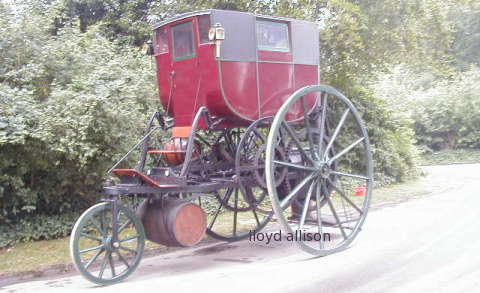
1803 (replica)- The driver sits up front, and the boiler and fireman are at the rear.
- Walter Hancock (1799-1852) built several steam powered vehicles.
One of these, the Infant, carried eleven passengers on
a trip from London to Brighton in 1832.
In 1833, his steam omnibus, Enterprise (!),
began a regular service between London Wall and Paddington.
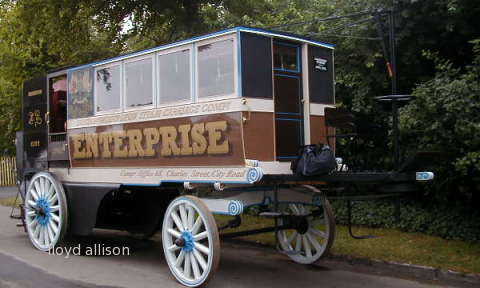
1833 (replica -- the boiler cannae take no more)- The Enterprise was rear-engined and was operated by a crew of three with the driver sitting at the front.
- There was considerable opposition to powered vehicles. The Turnpike Acts taxed them. Speed limits of 10mph (16km/h) in the country and 5mph (8km/h) in town were imposed by the Locomotive Act 1861. The Locomotives Act 1865 reduced these limits to 4mph and 2mph respectively and required a man on foot and carrying a red flag to precede each such vehicle by 60 yards to warn passers by. (The Highways and Locomotives (Amendment) Act 1878 removed the need for the man on foot to carry a flag.) The worst restrictions, particularly the requirement for the man on foot, were removed in 1896 when the speed limit for light locomotives was raised to a heady 14mph (22km/h). The London to Brighton run was held on 14 November 1896 to celebrate this victory. The run was recreated in 1927 and it continues into the 21C, held each November, as the London to Brighton Veteran Car Run for cars built before 1905.
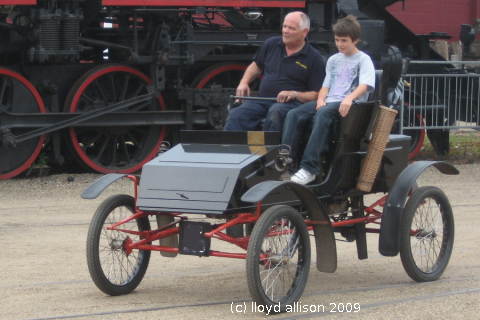
in 2009- 1902: Leon Serpollet raised the World Land Speed Record to 120.8km/h (75.06mph) in the Easter Egg Gardner-Serpollet steam car [Geo00].
- 1906: Fred Marriott driving the Stanley Steamer,
the Rocket, at Daytona raised the outright World Land Speed Record to
121.57mph (195.65km/h) [NT98] over 1km
(his speed of 127.66mph over one mile was not recognised internationally).
As a steam-powered record, this stood into the 21C.
(Bob Barber attained 145.607mph in a steam car on a run in 1985 but
failed to meet all the conditions required by the FIA
-- BSCC, 2008.)
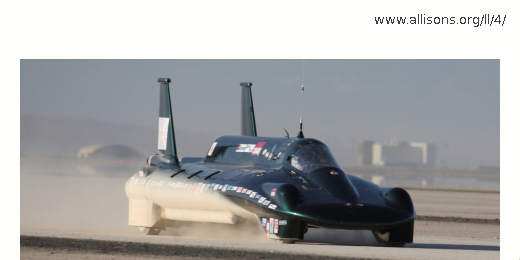
- 2009, August 25: The British Steam Car broke the World Land Speed record for a steam car, achieving an average speed of 139.843mph on two runs over a measured mile (and a peak speed of 151.085mph), at Edward's Air Force Base, California. The next day it set a record for one kilometer - an average of 148.308mph over two runs.