Australia Books Hartnett Imp 4x4 Tom Kruse Pioneers Round Expedition Expeditions |
West to East
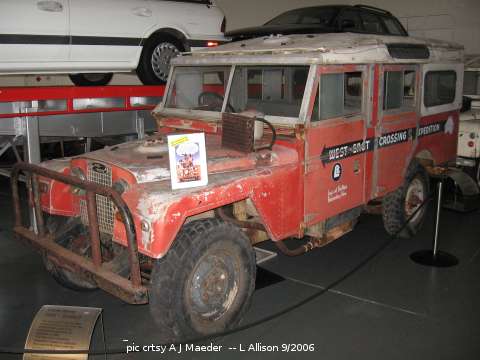
Above: The 1958 Land-Rover series-1 107" station wagon used by the Leyland Brothers in their 1966 West to East crossing of Australia. Members of the Land Rover Owners Club of Victoria organised a commemorative trip on the 40th anniversary, 2006.
The 1966 crossing took 36 months of dreaming, planning and trials; this trip was a first. It began 3 May 1966 at Steep Point near Shark Bay WA (the most western point of the Australian mainland, Indian Ocean). They passed through "Woodlie" sheep station, 450,000 acres. It was raining at Ayers Rock when they got there. It finished 20 August 1966 at Cape Byron NSW (the eastern most point, Pacific Ocean).
Way-points along the 26th parallel included Meekatharra, Wiluna, Carnegie, Gibson and Stony Deserts, Giles, Ayers Rock, Finke, Andado, Simpson's Desert (crossing took 22 days, 1105 sand ridges), Birdsville, Windorah, Cunnamulla, Goondiwindi, Lismore -- 111 days of travel, 4248 miles @ 17mpg (best road) and 3mpg (desert slog and 500 miles of mud in Queensland).
- Results and crew:
- The first successful W-E crossing ever achieved.
- (a) 2000 insect and 300 reptile specimens collected for Australian Museum naturalist Keith Davey.
- (b) Documentary 16mm film released Wheels Across a Wilderness, cinematographer Mike Leyland.
- (c) Book Where Dead Men Lie, Mike & Mal Leyland.
- (d) Cook, Pat Leyland.
- (e) Mechanic, Ted Hayes.
- The first successful W-E crossing ever achieved.
- Vehicles:
- A 1963 88" petrol Land-Rover hard top (9.00x16 aero sand tyres). Army style guards front and rear, front jerry bar and rear tool box on tailgate.
- A 1958 S1 petrol 6-cylinder station wagon (Michelin Sahara 7.50x16) fitted with capstan winch, HF radio, safari roof.
- A 1966 Bridgestone 90 Mountaineer motorcycle.
- A heavy duty (overloaded) 4 wheel trailer hand built with Land-Rover parts. Both Land-Rovers and the trailer were red with sign writing.
- No roof racks.
- A 1963 88" petrol Land-Rover hard top (9.00x16 aero sand tyres). Army style guards front and rear, front jerry bar and rear tool box on tailgate.
p.194: "A startling number of breakdowns, (mainly on the older vehicle, was both surprising and annoying, but a thorough understanding of the vehicles by the mechanic and the added safety of the second vehicle lessened the possibility of a disaster. Any one of the the breakdowns could have been a major catastrophe to anyone with no mechanical knowledge."
p.143: "we were sick of broken diffs" (Simpson Desert).
|
www #ad: |